When you are planning a construction project, designing a landscape, or organizing an athletic event, understanding specific dimensions is essential. People often ask, "how long is 75 feet" when they need to visualize a distance that exceeds the length of a typical room but falls short of a full city block. This measurement is a standard in various fields, ranging from residential lot depth to swimming pool design. Understanding this length in multiple units helps ensure accuracy in your planning and execution.
MeasurementsOctober 22, 2026
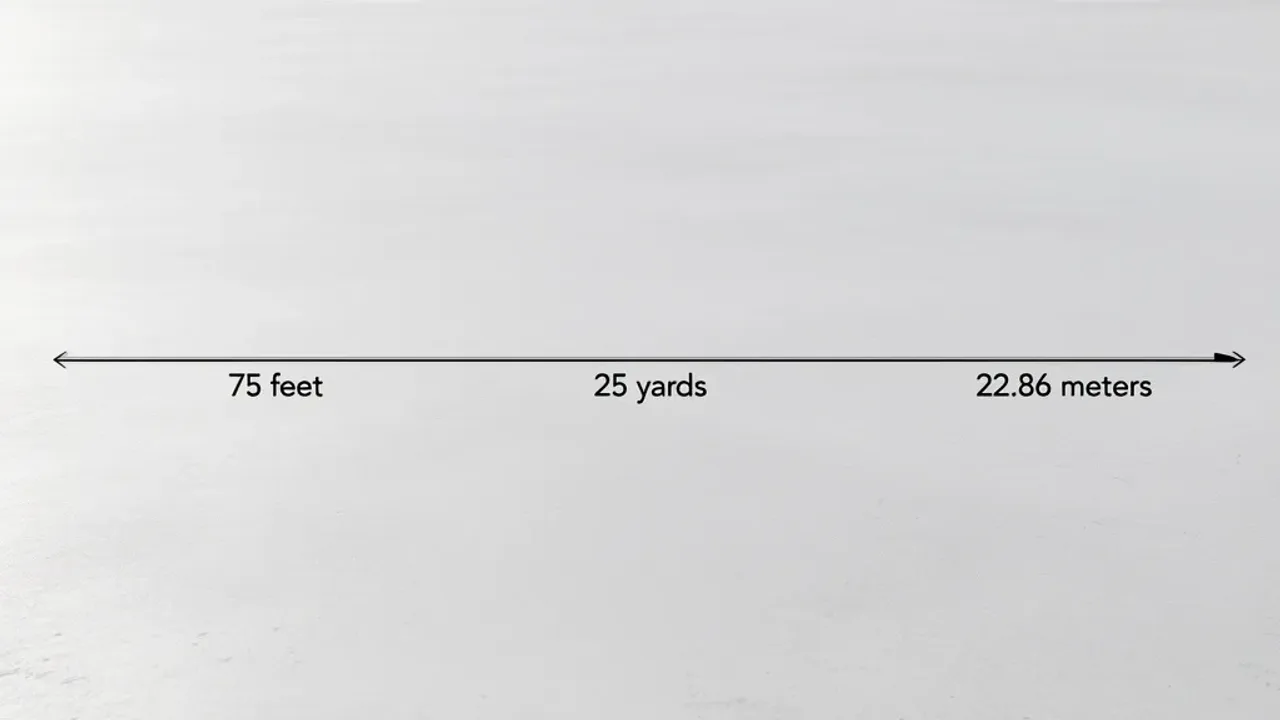
How Long Is 75 Feet? (25 Yards and 22.86 Meters)
 AI-generated image
Key Takeaways:
- Seventy-five feet translates to exactly 25 yards.
- The value in metric units is 22.86 meters.
- You can calculate this distance by using the standard conversion factor where one foot equals 0.3048 meters.
- This measurement is frequently used for residential lot depths and athletic training lanes.
Visualizing 75 Feet in Common Measurements
To grasp the scale of 75 feet, it is helpful to look at how it relates to other common units of measurement. In the imperial system, the relationship between feet, inches, and yards is fixed. Because one yard consists of three feet, dividing 75 by three provides an easy way to visualize the length as 25 yards. This conversion is straightforward and widely used in sports such as football, track, and swimming.
For those who prefer metric units, the conversion relies on the international standard where one foot is defined as exactly 0.3048 meters. By multiplying 75 by this factor, we arrive at the precise figure of 22.86 meters. When researching "how long is 75 feet", many find that the precision of these conversions is vital for engineering and design consistency. Maintaining accuracy prevents errors in material purchasing and spatial planning.
| Unit | Total Value |
|---|---|
| Yards | 25 |
| Inches | 900 |
| Meters | 22.86 |
| Centimeters | 2,286 |
If you are visualizing this length in a real-world setting, consider the following comparisons to help frame your perspective:
- Residential Lots: Many suburban properties feature a backyard depth of approximately 75 feet.
- Athletics: Short-course swimming training often utilizes lanes that align with standard yardage.
- Vehicles: A row of several large passenger vehicles parked bumper-to-bumper can easily span this distance.
- Architecture: Building setbacks from a street often hover around this specific length for safety and utility access.
Practical Applications and Considerations
This length appears frequently in professional and recreational contexts. Whether you are a homeowner installing a new fence or a contractor laying out a recreational court, following standardized measurements is critical. To ensure accuracy when planning your next project, follow these logical steps:
- Assess your site: Verify the scale of your blueprint or physical site map against the 75-foot reference.
- Convert correctly: Apply the 0.3048 multiplier if you must translate the value to meters for international standards or specific equipment requirements.
- Account for margins: Always double-check your measurements if the space requires exact clearance for vehicles, safety walkways, or equipment.
Knowing exactly "how long is 75 feet" allows for better coordination during the initial phases of site development and equipment installation. Accurate planning prevents costly errors. It helps immensely. Precision is the foundation of every successful project.
Construction and Engineering Contexts
In the world of construction, 75 feet is a common benchmark for site utility. For instance, when installing drainage systems or electrical conduits, knowing this length helps in calculating the total volume of materials required. Because standard lumber and piping often come in 10, 12, or 20-foot lengths, understanding how 75 feet fits into these increments can save time and reduce waste on the job site.
Athletic and Recreational Uses
Sports facilities frequently utilize 75-foot increments for training drills. Whether it is a sprint distance, a specific zone for agility training, or the length of a localized practice area, this measurement is standard. Athletes rely on consistent spatial references to improve their performance, and knowing the exact distance ensures that training environments remain uniform across different locations.
Advanced Conversion and Mathematical Relationships
Beyond the basic conversion, understanding the mathematical derivation of these numbers provides depth. The imperial system is deeply rooted in the history of measurements, and while the metric system is the global standard for science, the imperial system remains the backbone of American construction. The consistency of these units allows for reliable communication between designers, builders, and clients.
When you need to perform more complex calculations, such as determining the area or volume of a space that is 75 feet long, the math remains linear. For example, if you have a rectangular space that is 75 feet long and 20 feet wide, the total area is simply 1,500 square feet. This simplicity is why designers favor round numbers like 75 when drafting preliminary sketches.
Frequently Asked Questions
Is 75 feet the same as 25 yards?
Yes, 75 feet is exactly 25 yards. Since there are three feet in every yard, dividing 75 by three gives you the exact yardage, making it a very common measurement in sports and construction.
How many meters are in 75 feet?
There are 22.86 meters in 75 feet. This is determined by multiplying 75 by the standard conversion factor of 0.3048, which is the internationally accepted length of one foot in meters.
Why is this distance common in construction?
This measurement is often used for residential lot depths and driveway lengths. It serves as a standard dimension for planning space in suburban and commercial layouts, fitting well within typical zoning requirements.
How many inches make up 75 feet?
There are 900 inches in 75 feet. You arrive at this figure by multiplying the total feet by 12, which is the number of inches in a single foot.
Can I use this measurement for swimming pools?
Yes, 75 feet is often associated with the length of shorter swimming lanes. It provides a consistent distance for training and competitive practice sessions, especially in facilities that do not host Olympic-length events.
Are there variations when measuring 75 feet?
The distance itself is constant. However, depending on the tool used—such as a laser measure versus a physical tape measure—minor discrepancies can occur. Always calibrate your tools before starting a project to ensure the highest level of accuracy.
In summary, 75 feet is equal to 25 yards or 22.86 meters. Always utilize standard conversion factors to ensure your measurements remain accurate for any task.
Share: