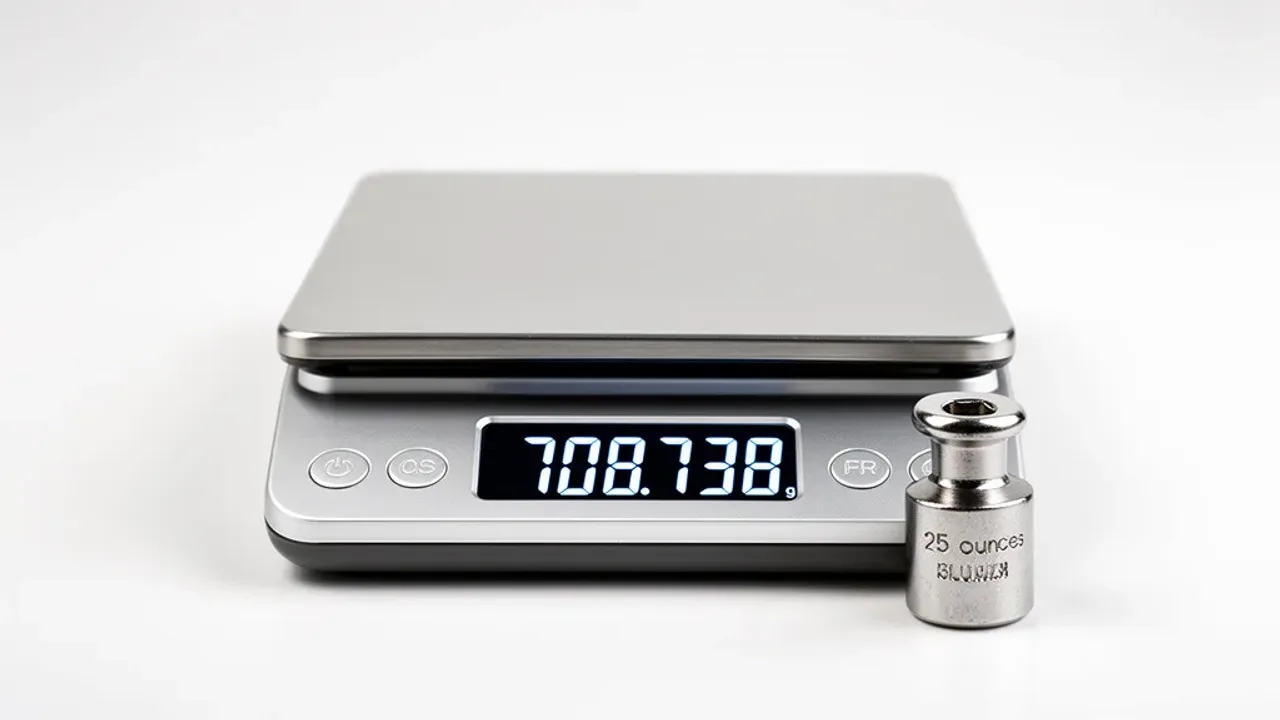
Converting 25 ounces to grams results in a total mass of 708.738 grams. This figure is essential for anyone requiring precise measurements in a metric format. The avoirdupois ounce serves as the standard unit of weight in the United States, yet many international contexts require the use of grams for consistency. Understanding how these units relate ensures that your measurements remain accurate across various scientific, commercial, and culinary applications.
ConvertersSeptember 3, 2026
25 Ounces to Grams: 708.738 Grams Conversion Guide
 AI-generated image
Key Takeaways:
- The result of 25 ounces to grams is 708.738 grams.
- The conversion factor for one avoirdupois ounce is 28.3495 grams.
- Always verify if the weight unit is an avoirdupois ounce or a troy ounce.
- Precision is vital for successful results in chemistry, baking, and shipping.
Conversion Calculation Explained
To determine the mass in grams, one must multiply the total number of ounces by the conversion factor of 28.3495. This mathematical process provides a precise metric equivalent for the avoirdupois ounce. It is the most common weight unit for consumer goods and general logistics. When a person calculates 25 ounces to grams, they simply apply this constant. The result is exactly 708.738 grams.
This conversion relies on the international standard where one avoirdupois ounce is defined as 28.349523125 grams. For most practical purposes, rounding to three decimal places is sufficient. Maintaining this level of accuracy is important. It prevents errors in formulation and logistics. Whether you are working in a professional laboratory or a home kitchen, the principle remains the same. Every fraction of a gram counts toward the final accuracy of your work.
Keep these steps in mind during the process:
- Identify the total number of ounces you need to convert.
- Locate the conversion constant of 28.3495.
- Multiply the two values to obtain the final weight.
- Verify your result against standard conversion tables.
| Ounces (oz) | Grams (g) |
|---|---|
| 1 oz | 28.3495 g |
| 5 oz | 141.747 g |
| 10 oz | 283.495 g |
| 20 oz | 566.990 g |
| 25 oz | 708.738 g |
Practical Application
Accurate weight conversion is a fundamental requirement for international shipping and laboratory experiments. Precision ensures that items are handled correctly and that recipes remain consistent. Whether preparing a complex meal or calculating postage for a package, understanding these metrics helps you avoid costly errors. Accuracy matters. It is the foundation of reliable measurement.
- Ensure all weighing scales are properly calibrated before use.
- Check the specific weight standard required for your task.
- Rounding to three decimal places is the standard for most general applications.
- Document your conversions clearly to assist with future tasks.
Frequently Asked Questions
How is the conversion calculated?
Multiply the number of ounces by 28.3495. This is the recognized metric equivalent for the avoirdupois ounce used in the United States.
Are all ounces the same?
No. The standard conversion applies to the avoirdupois ounce. Troy ounces, often used for precious metals, require an entirely different formula.
Why convert to grams?
Grams align with the metric system. It is the global standard for scientific research, trade, and international commerce.
What if the factor is wrong?
Errors may occur in high-precision tasks. Always stick to the 28.3495 constant to ensure consistency with global standards.
Is 25 ounces a standard weight?
It is common for packages that exceed the standard one-pound limit. Using 25 ounces to grams helps with accurate postage calculations.
Summary
Converting 25 ounces yields 708.738 grams using the standard factor. Always verify your specific units to ensure your measurements remain accurate and consistent.
Share: