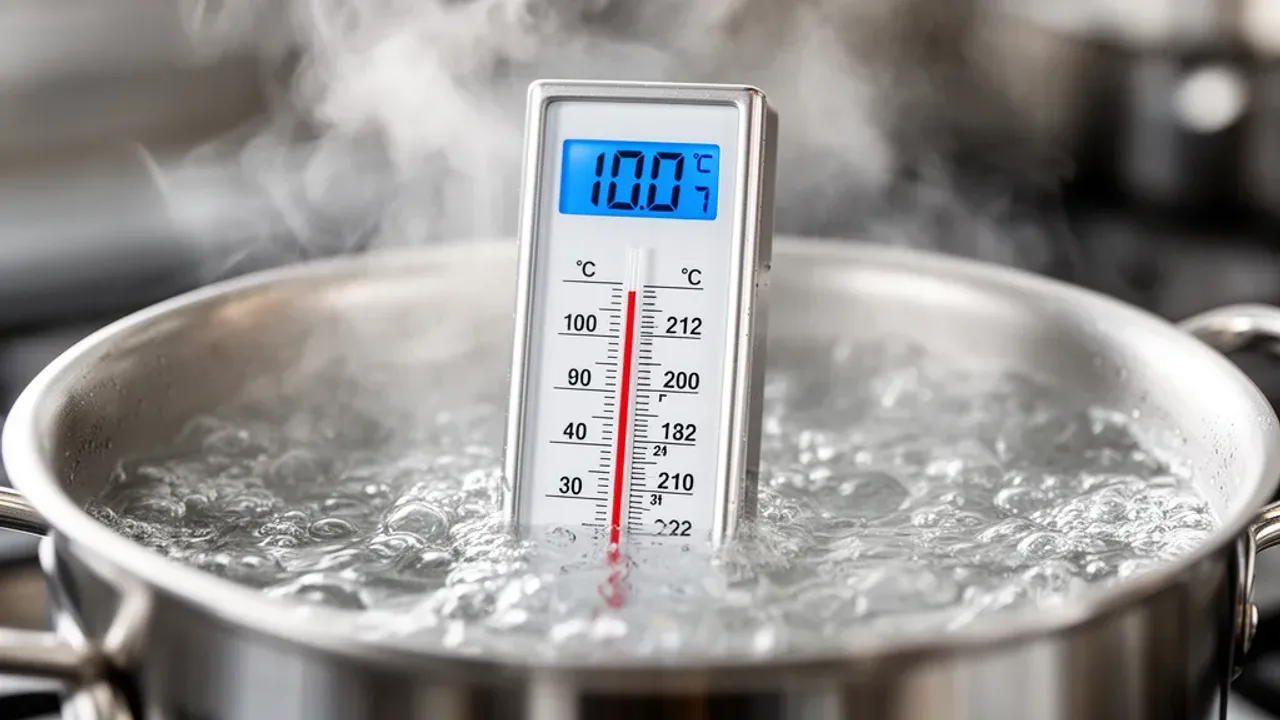
100 degrees Celsius is equal to 212 degrees Fahrenheit. This specific temperature is a fundamental reference point in both scientific research and everyday culinary tasks. When you search for 100 celsius to fahrenheit, you are identifying the exact boiling point of water under standard atmospheric pressure at sea level. Understanding this relationship helps ensure accuracy in everything from laboratory experiments to simple kitchen recipes.
ConvertersOctober 9, 2026
100 Degrees Celsius to Fahrenheit: 212°F Conversion Explained
 AI-generated image
Key Takeaways:
- 100 degrees Celsius is equivalent to 212 degrees Fahrenheit.
- The conversion is based on the physical properties of water at sea level.
- Multiply the Celsius value by 1.8 and add 32 to determine the Fahrenheit equivalent.
- These two temperature scales are used globally for scientific and daily measurements.
The Conversion Formula
To convert any temperature from Celsius to Fahrenheit, you must follow a standard mathematical process. You multiply the Celsius degree by 1.8 and then add 32 to the final result. It is that simple. This method allows you to perform any conversion without relying on digital tools every time you need to determine the equivalent of 100 celsius to fahrenheit.
The formula is expressed as follows:
- Multiply the temperature in Celsius by 1.8.
- Add 32 to that product to find the value in Fahrenheit.
- This calculation works for any positive or negative Celsius temperature.
| Celsius (°C) | Fahrenheit (°F) |
|---|---|
| 0°C | 32°F |
| 20°C | 68°F |
| 50°C | 122°F |
| 80°C | 176°F |
| 100°C | 212°F |
Practical Application
Understanding this conversion is essential for various daily tasks. Consider these steps when working with temperature settings to ensure accuracy in your projects:
- Verify the scale used by your equipment or recipe before starting.
- Use the 1.8 multiplier for quick mental estimations.
- Confirm the atmospheric pressure if you require extreme precision, as it affects the boiling point.
Temperature measurement is a vital part of modern life. Whether you are baking, conducting chemistry, or simply checking the weather, knowing how to switch between these two systems provides significant utility. It takes minimal effort to master the math. Once you memorize the 1.8 factor, the process becomes second nature.
Frequently Asked Questions
Is 100 degrees Celsius always 212 degrees Fahrenheit?
Yes, 100 degrees Celsius is defined as 212 degrees Fahrenheit under standard atmospheric pressure conditions at sea level. This remains a constant physical relationship across all scientific disciplines.
What is the easiest way to convert Celsius to Fahrenheit?
The most reliable method is to multiply the Celsius number by 1.8 and add 32. Alternatively, you can double the Celsius temperature and add 30 for a rough, quick estimate if you are in a hurry.
Why does water boil at 100 degrees Celsius?
The Celsius scale was designed around the properties of water, setting the freezing point at 0 degrees and the boiling point at 100 degrees. This provides a clear, decimal-based reference for scientific and everyday use.
Are these scales used differently in various regions?
Many countries utilize the Celsius scale for official measurements and weather reporting. The Fahrenheit scale is more commonly used in the United States for consumer and meteorological purposes.
Can I use the same formula for negative temperatures?
Yes, the mathematical formula works for all temperature values. Simply multiply the negative number by 1.8 and add 32 to arrive at the correct Fahrenheit measurement.
Summary
The conversion of 100 celsius to fahrenheit results in exactly 212 degrees. Always use the multiplier of 1.8 followed by the addition of 32 to ensure your temperature calculations remain accurate.
Share: